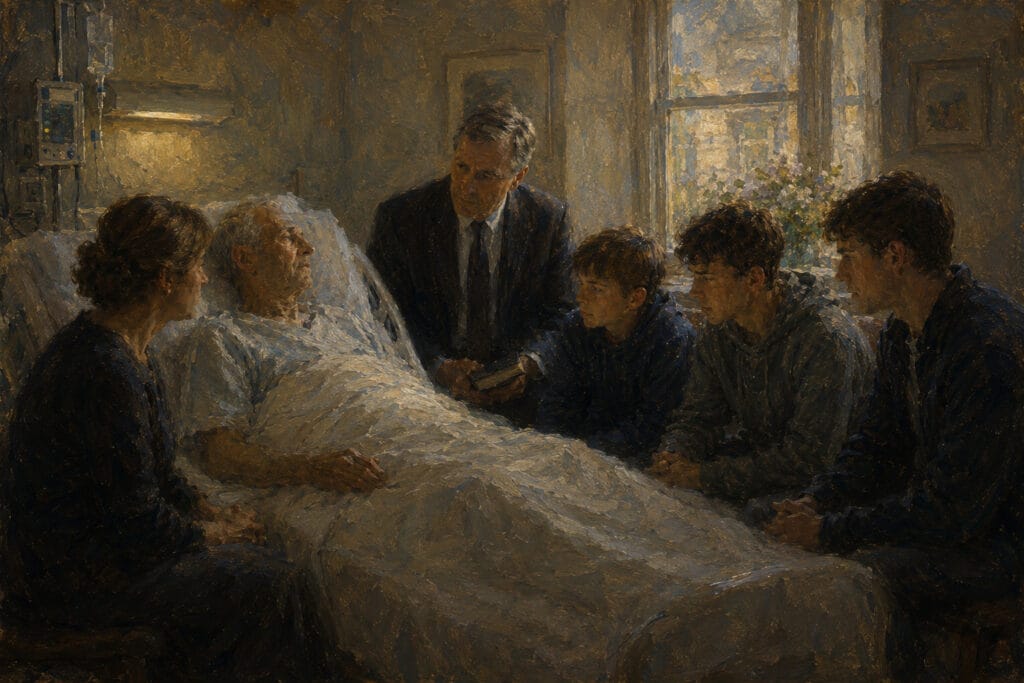
Jim Barley was going to die soon.
He’d been told this plainly and accepted it
almost like a bad weather forecast. And
being a man whose life’s work with the U.S.
Navy had to do with the analysis of things,
he’d considered his situation, made lists of his
priorities, and marked things off one by one as
he had always done.
The last of all those things was to
talk with each of his three sons about
their lives without him.
These talks were scheduled, and the boys came,
serious like final exam day. He called them
to his bedside one by one beginning with the
last born and ending with the first.
The door was closed each time for privacy.
Then all of us were invited in and gathered around
his bed. There was an unsettled quiet in the room.
The list of things that needed doing was quiet too.
Jim looked all around and finally said, as if to
the world he still lived in:
What do I do now?
The question hung suspended in that hesitating
air. And we wondered was it a joke, or serious like
the Navy, or medical like the doctor, or
something else entirely?
The question roamed around the bedside and
across the clean mopped floor and up to the
overhead lighting for an answer. There was
none.
He lived on for about two more weeks as heaven
waited.
Then his answer came.
Afterword – From 38 years ago
I was fortunate to have saved my brief message from the funeral of Jim Barley. This is what I said at his service on June 30th, 1988.
Scripture readings: Romans 8:1,18, 28-31b; Romans 14:7-9; Ephesians 2:4-8; 2nd Timothy 4:6-8; Revelation 21:1-4
Jesus had a disciple–one of twelve–and his name was Thomas. Thomas was an analyst. He was always asking questions. He was sometimes hard to convince.
Jesus was speaking about the way to heaven, and he said to the group, “You know the way.” And the guys were standing around and wondering what that meant. They weren’t about to say anything, though. All except Thomas. He spoke up and said, “Lord, we don’t know. I’m sorry, but we don’t know. Please tell us about it.”
He was that sort of person. Whose faith isn’t easy or automatic. Who has to have an answer. Who has to think it through. Who can’t be phony or dishonest. Who tries to be sure but is never quite sure.
Jim Barley was my friend, and I think I knew him, and I think that’s who he was. He was like Thomas.
Thomas who was absent when the resurrected Jesus first appeared to the disciples. And so they told him about it. And he said, “Well, I’d have to see that for myself. I’d have to see the print of those nails in his hands, and the mark of that spear in his side. I’d have to know more about a thing like that.”
He didn’t say it wasn’t so, he just said he’d have to know more about it. He was not about to base his faith on second-hand evidence.
But in the story of Thomas in the Bible, the Lord appears again to the disciples with Thomas present. And he offers to let him put his fingers in the nail holes, and the spear hole in his side. And confronted with this evidence, Thomas gives one of the loftiest confessions of faith in all of scripture. He says, “My Lord, and my God.”
For a man like that, the path to faith winds it way through a valley of doubt. Good doubt–honest doubt. Things must be figured out. Time taken, books read, conversations held, analysis made. But when the list is finally complete, the conclusion is sure.
Jim was a list man. He made his lists, and he checked things off.
I was with Jim at the hospital one day and I said, “Is there something I can do for you?” I meant can I tell someone something? Can I call the nurse to give you a shot? Can I write down the details for your funeral service? “Is there anything I can do for you?”
And he said, “Yes.” And I waited. And what he said was, “forgive me.” It was so unexpected, I didn’t believe that’s what he’d said at first. So I had him repeat it, and he did. And then I began to think back. I thought, what in heaven’s name can this possibly mean? I knew of nothing. So I said, “Forgive you for what?”
And he mentioned something that seemed very trivial there in that room. Something I never in a moment held against him. And I started to say there was no need for my forgiveness–there was nothing to forgive. But then I remembered we had a dying man in the bed there, and I mustn’t tell him there was no need of my forgiveness. I must tell him he was forgiven.
Forget what I thought about the thing, it was what he thought that mattered. So I said the words he asked to hear–“I forgive you.” And that was that. But it shows what a struggler the man was, and how serious he was, and how methodical, and how it mattered to him that he go to God with a slate a clean as he could possibly get it.
There could be someone whose forgiveness you ought to ask for. Jim leaves behind this testimony of a person’s need for that.
We all mess up. We say what we shouldn’t say, and do what we shouldn’t do. We condemn people for the smallest of sins, and excuse ourselves for large ones. We hide our real motives, which are selfish at best. We give lip-service to God while living the life of a practical atheist. We have much to be forgiven of.
To know that, and feel that, is of crucial importance. Jim did. And he had to be sure, and he had to be honest. He had to ask all his questions, and get all his answers. He had to assemble all his charts and all his comparisons. Like Thomas the disciple, he had to do that.
But the Lord loved Thomas, and understood him. And the Lord loves Jim, and understands him. Even though I suspect that in Heaven he’s already asked a lot of questions about the place!