Nature

That’s A Lot to Swallow

I’ve been watching cormorants lately. They are fascinating birds. They gather in great numbers below the Conowingo Hydroelectric Dam on the Susquehana River in Maryland near the northern end of the Chesapeake Bay.

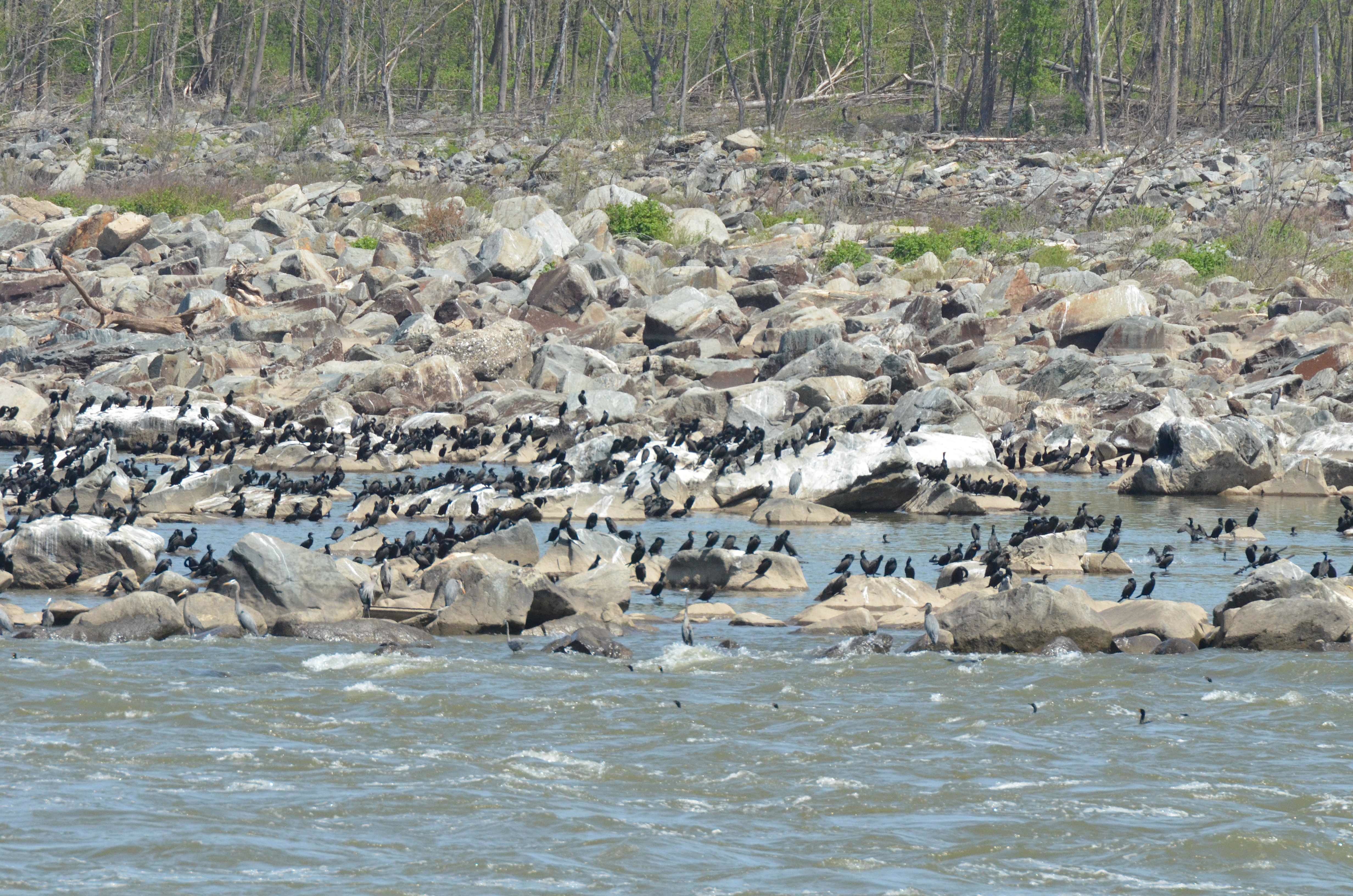
Did I say “in great numbers?” Just survey a portion of the gathering (click to enlarge). The cormorants are the black birds and the most numerous. Harder to see are the ones fishing in the rushing water. Unlike ducks, the feathers or cormorants are not buoyant, so they sink down in the water instead of riding up on top of it. The reason their feathers don’t float is so they can dive down for food, which most ducks can’t do. Cormorants can dive down very deep after food, although fishing is so good below Conowingo that they likely get plenty to eat not far beneath the surface.

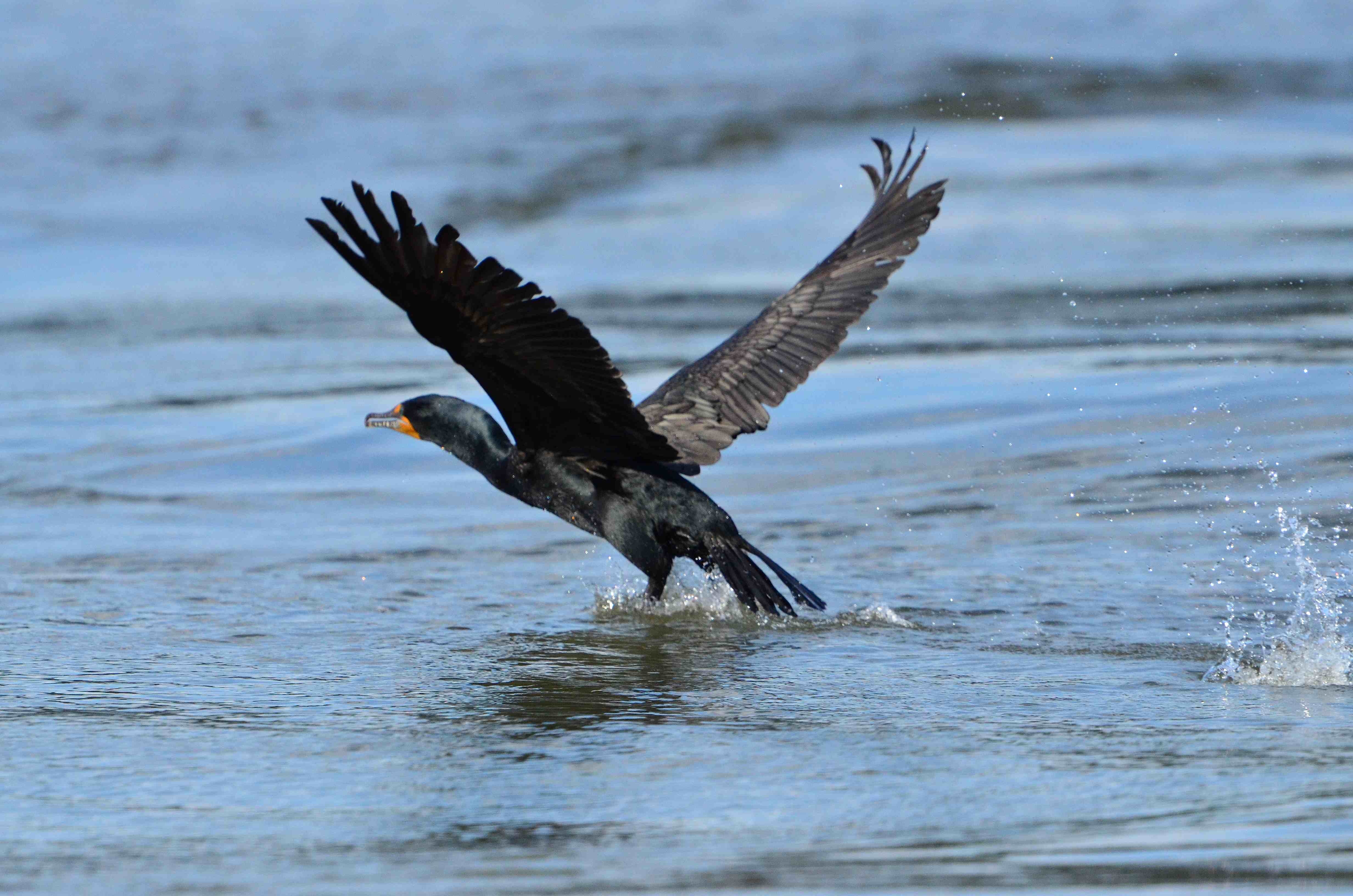
Since the feathers of cormorants get wet and heavy, the birds have a struggle to get airborne during a water takeoff. Their wings have to work really hard and also their webbed feet need to help out as well. It takes a good distance and creates a lot of fuss. A feeding cormorant may have to perform these takeoffs numerous times before catching a fish. They fly up close to the dam and land, then float downsteam watching for their next meal. If they don’t find it by a certain point downstream, they takeoff and land upstream again. 

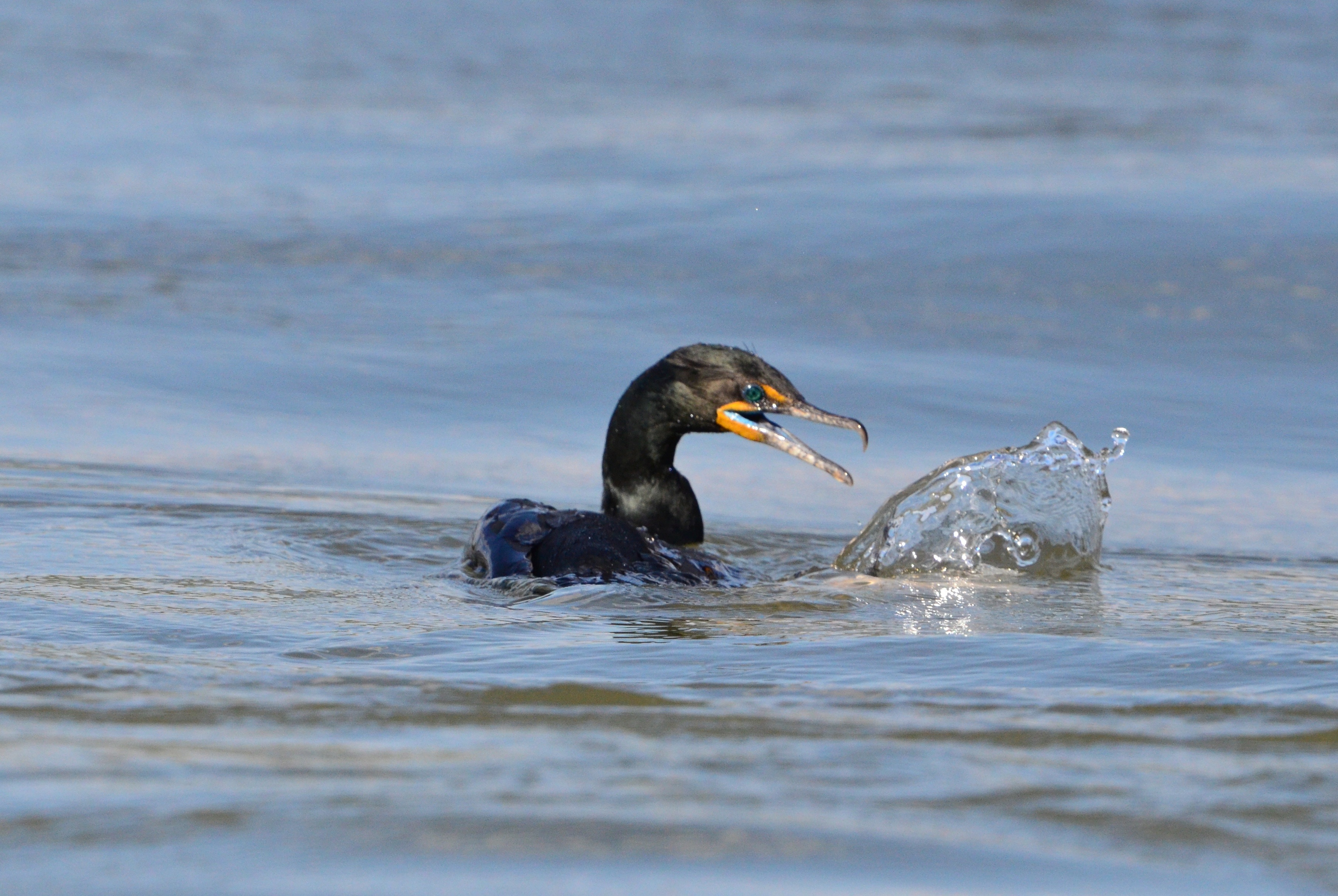
There are 40 some varieties of cormorants. These are the most common in our area — the double-crested cormorant, so named because the male sports a second crest during the mating season. As shown here, the birds have a fearsome weapon for snagging fish. Not only are their beaks long and needle sharp, the top part has a wicked hook in the shape of, well, a fish hook. Imagine being a fish and having that thing come toward you at lightening speed. And this only moments after you got churned through the massive turbines of Conowingo dam.

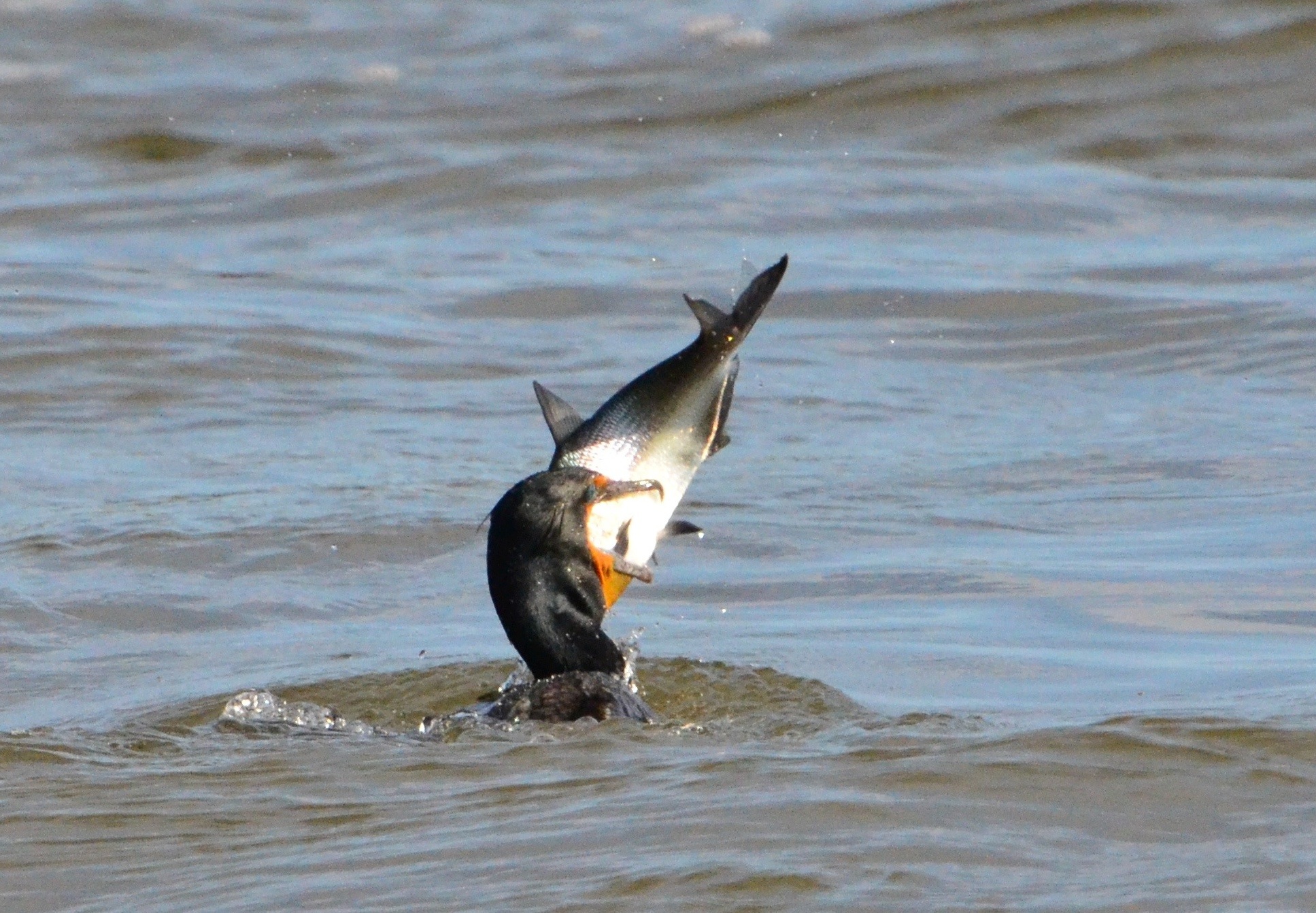
When a cormorant dives down and gets a small fish, it will swallow it under water. But when it catches a large fish, it must bring it to the surface and perform an amazing maneuver. It has to release the fish from its beak, flip it so the head is pointing down and the tail pointing up, and catch it just right for swallowing. As my picture shows, they can swallow very large fish, and all without the aid of any hands, fingers, claws, or feet. Because this flipping and swallowing operation has to be so precise, it is also an opportunity for a fish not inclined to be swallowed to wiggle and get away.

A further aspect of cormorant activity at Conowingo is the turbulence and speed of the river. The best fishing is when the turbines are running and the river swolen and rushing. In the short video that follows, you will see them seeking and catching their food in water no human swimmer would attempt. You will see many of them sunning and watching from dry rocks while others churn past them. We assume that most of the watchers have already had success and are settled to dry off and digest their meals. This video represents a 55-second slice to time on the river. I have counted in it 17 bald eagles, 7 great blue herons, and at least 4 of the comorants visibly catching fish.

[youtube]http://youtu.be/4l_FvDYaYtM[/youtube]
Open Water Swim Events Swimming

Nanticoke River Swim 2013

It is not entirely clear that human beings were intended to swim in water. Compared to fish and birds and other swimming animals, we are slow and very limited. Still we, and I, keep trying. Doctors tell us it’s great exercise. As a former runner, I know it beats pounding the pavement with my feet, ankles, knees, and hips. 

The earth is covered with a lot of unfrozen water where swimming can take place. There are oceans, bays, rivers, and lakes abundant. But for most of us, swimming takes place in artificial man-made pools filled with clean, filtered water and with life guards watching. There are well marked swim lanes of measured distances and timing clocks to consult. There is a uniformity, a sameness, about swimming in these places, whether indoors or outdoors. I know that in a pool with 25 meter lanes, I need to do 64 lengths, 32 laps, to make a mile. There is no risk of getting lost or off course. Just follow the black line on the bottom of the pool. 

But swimming in the lakes and rivers and oceans is a different matter. And swimming in a tidal river like the Nanticoke on the Eastern Shore of Maryland is especially so. If this account of the 2013 swim is of interest, do read my account of the same Nanticoke swim event from 2012. …

Advice People

Things My Mother Said to Me

What do you do when it’s Mother’s Day and your mother is only a memory? I guess you take some time to remember.

My mother was a kind and loving person with a simple Christian faith and a multitude of friends. She had three sons, but lost the oldest of them in World War II. As a Christian and loyal American she accepted that loss, but she felt the pain of it all the rest of her life. I was her youngest son. Although mother has been gone for many years now, I still feel her love and influence. 

Like everyone else, mother thought about the meaning of life and what it meant to live it well. I was given the strong impression that my life was important and that I had a responsibilty to make the most of it. I was given the strong impression that the success of my life depended not only on what I did for myself but what I would do for others. In other words, I had a moral and social responsibility. And this coincided with my responsibility to God, my maker. In mother’s view, we all had responsibilities to be taken seriously. Many of these were reflected in her repeated sayings. …

Stories

A Honda Story

In the early ’60’s I was a seminary student in Louisville, Kentucky and pastor of a rural church about 70 miles away. Most of the church members were farmers, although some worked at Fort Knox and a few drove in to Louisville to work. I had come from neighboring Tennessee and was well accepted in the community. Like most of the men and young men, I was a hunter and fisherman. Like my father before me, I read “Field and Stream” magazine, and that is how my Honda story begins.

I noticed a classified ad in the back of Field and Stream. It showed a small two-wheeled vehicle with a luggage rack. A hunter was riding it down a trail in the woods and carrying a deer on the back. It looked like, and was, a small motorcycle, but it was described as a “trail machine.” I was immediately curious and intrigued, for this was unlike anything I had ever seen. Motorcycles, at that time, were large and loud and ridden by disreputable characters, or so said the popular stereotype.

The trail machine was made by a company I had never heard of — Honda. It was also a company America had never heard of. Turned out it was a Japanese company. At that time Japanese companies were stereotyped as flooding American markets with “cheaply made foreign goods.” But this did not deter my interest in the Honda Trail Machine. …

Religion

New Feature

New featureI have added a new feature which may or may not be of interest. I’ve had some scanning done and have posted text from my books, sermons, and music from years gone by when I was a minister and pastor of Baptist churches. I may later add a section for poetry.

This is all under the new “Publications” tab which you see above. Each of the sections and sub-sections has a brief introduction. The “Sermons” section is just a start for now. I have posted the first of what will eventually be around ten volumes.

I am not attempting to revisit or revise any of these writing, but the task of formatting for the web can be time consuming.

When they see the term “Baptist” most people read “conservative.” This was not always the case. I was a liberal Baptist. One of the last.

Alcohol Health Stories

Repetition

The man would wake up early trying to remember the night before. There was always a nagging fear that he had messed up. But he must get dressed now and get to work. The man was well thought of there, a nice man, everyone said. And he did his work well, so  things were good apparently. But as the office morning turned to afternoon, the man’s thoughts were drawn to leaving work and to the evening ahead. The day was about the evening.

repetition-champane-glassesHe had quit keeping liquor in the house because he drank too much if a supply was present. Getting some at the store and drinking in the evening became a day-to-day decision. He had more control that way. Often he would start the day determined to drink nothing. But by afternoon the urge would take hold and reasons appear as to why he deserved it today. Something bad had happened, or something good to celebrate, it didn’t matter. Any reason was a good reason. Always it seemed justified.

His present routine was to get two large bottles of fortified beer for the drive home, and a jug of wine for the evening. White chablis was his current choice. As he drank the beers in the car, bottle between his legs, he timed it so other drivers would not see, especially policeman drivers. And as the familiar feelings appeared, he reminded himself often to drive carefully. He considered himself a skilled drinking driver.

The man was always eager to get home and get started on the wine. Anything that might delay this could wait. If a neighbor waved and seemed to want something he would fail to notice. Once inside the door, all seemed right with the world. There was plenty to drink and an evening ahead. …

People Stories

The Cardboard Box

My father grew up poor in the mountains of western North Carolina. He was one of eleven children and the only one to finish high school, much less earn a Ph.D. Although he became a college professor, he never forgot his early struggles. Also he lived through the Great Depression, which those who did so always remembered. They seemed to carry in the back of their minds that this could happen again. They must not waste things. They must “save for a rainy day.”  Because of this I never heard my parents complain about the rationing during World War II. I did hear them complain about families in our town who were alleged to cheat on the rationing and get more than their fair share of rationed items.

My father would have listened with sympathy to all the complaints about wasteful government spending today. But he would not have failed to notice that many of the complainers are wasteful spenders themselves. The idea of people owning mansions all over the country and some with elevators not only for themselves but for their expensive cars, that would not have been well received. My dad never bought a car that was not a Chevrolet, and it was always the simplest and lowest priced model available. If it had a radio and windshield wipers and room enough in the trunk, it would do.

He made a large garden every year. We had fresh corn, peas, onions, tomatoes, squash, okra, beans of all kinds including soy, cabbage, carrots, beets, broccoli, turnips and their greens, collards and kale, garlic, lettuce, and always something new and experimental. The arrival of the Burpee seed catalog each year was welcomed with much interest. Before there was a grocery store called “whole foods” my parents made much use of them. Mother canned and froze food from the garden and dad helped. It was economical, and it was healthier. …

Open Water Swim Events Swimming

The Great Chesapeake Bay Swim – 2013

Yesterday I got welcome news. My entry into the lottery for the 2013 Chesapeake Bay Swim was drawn and I am now registered for the swim on Sunday June 9th. Some 1200 of us entered the lottery, and about 700 of us were drawn and allowed to register. This will be my fourth bay swim event. Review my experiences with the 2012 swim here.

bay swim startI ran across some pictures from previous swims.  The upper one shows a typical start from the beach at Sandy Point State Park on the western side of the bay. Do not imagine that I'm one of the mass of bodies surging ahead in the water.  I'm one of those in the back with arms folded, waiting for the crowd to thin out!

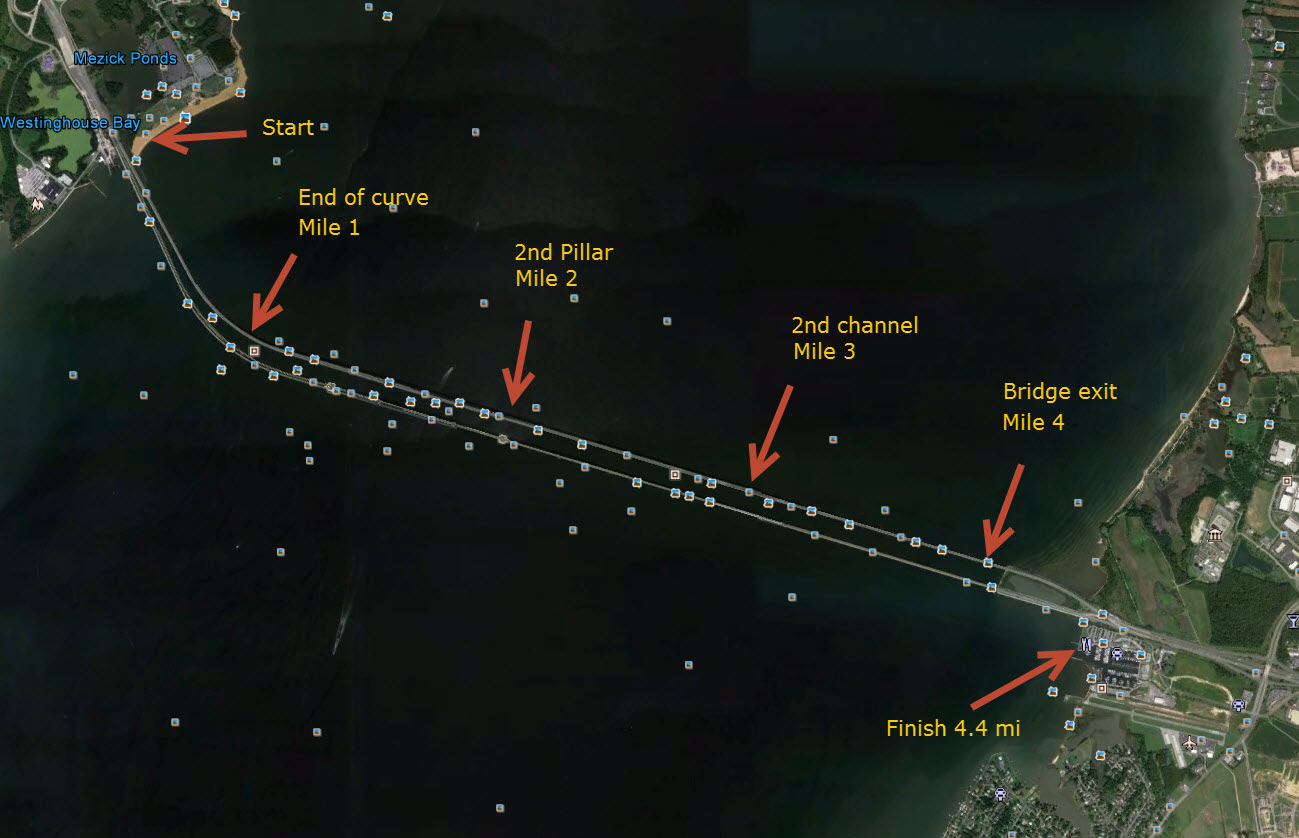
The lower picture shows a typical finish from the small beach at Hemingway's Marina on the eastern side of the bay. In between this and the start is 4.4 miles of water and, for me, over two and a half hours of navigating and swimming. In open water swimming, navigation assumes an all-important role, especially given the shifting tides and currents you experience during this crossing.

The start and finish beaches are both outside the Chesapeake Bay Bridge, BaySwim_061310_swimmersbridge2although most of the swimming takes place inside the two great bridge spans.

I am trying a somewhat different training strategy for this year's swim. Last year I started training in December for the June swim. I set a goal of swimming ten miles a week and pretty much kept with it.  I typically set the clock for 4:50 a.m. and was in the water at 6:00.  There was nothing wrong with this approach, but this year I am trying something different.

This year I plan to swim less miles but to do more intensive speed workouts and dry land exercises. I am doing 100 meter sprints as fast as I can go, resting 60 seconds, and then going again.  I am aiming to do a couple of miles worth of these a week, plus a variety of strength training for swimmers.  I may only put in 7 miles or so of swimming a week, but I think this may work well.

I'll know after June the 9th.

Commentary Sports

How Many Socks? – Reprise

This is a followup to a post of 2011-01-01 titled “How Many Socks?”  To review, just search for it or click the following link – https://edbriggs.com/edbriggs/2011/01/01/how-many-socks/  

Continuing on the subject of socks, let me mention the Thorlo brand. I first became aware of Thorlo socks when I started running in the ’80’s. The Thorlo running sock was bar-none the very best to be found. They were cushioned, well fitting, and lasted almost forever. They did cost a lot, but since running requires little besides shoes in the way of equipment, the cost seemed incidental. I have had Thorlo athletic socks perform for many years despite constant service.

Over these years, Thorlo has expanded its line again and again. It now includes a sock for every activity you can think of, and in multiple styles and colors and configurations. …

Commentary

The Nickel Effect

For as long as I can remember, there have been “grocery bags.”  First they were paper, then they were also plastic, and often now you have a choice. But for the past year in Montgomery County, Maryland, you also have another choice. You pay a nickel for every bag you get from the store. But you have a choice of bringing your own reusable bags and avoiding the 5 cent charge.

The logic behind this policy is fairly evident. When bags were all “free,” we bagged things wastefully and created mountains of trash. Also paper bags are made from trees and plastic bags are made from petroleum. Petroleum is a resource the world is running out of, and burning it creates gases that contribute to global warming. Cut-down trees can be replanted with seedlings and replaced over time, but we are cutting our forests much faster than we are re-growing them. Saving our wood and oil just makes sense.

The transformation in people’s shopping habits during this first year of the new law has been remarkable. In the early months, few people brought bags from home and just paid the extra charges. But every 5 cent charge you paid was a reminder. You began to notice more and more people bringing their bags, and you made mental notes to do the same. When you forgot, you scolded yourself and felt stupid. As you carried your groceries out in plastic, you imagined people staring at you disapprovingly. Then you became a regular.

Social distinctions then appeared. The “better” stores have their own better bags including their branded snob appeal. Not many people are seen bringing Wal Mart bags in to shop at Whole Foods. (Bill Maher’s name for Whole Foods is “Whole Paycheck.”) But the new law applies everywhere and is no respecter.

I have not seen figures on the amount of wasted wood and petroleum saved by this one law in this one county, but it has to be significant. I do not know the effect if the law became a national one, but the result would have to be huge. 

Like others, I was resistant to this law at first. But in these few short months, I have become a willing supporter. Bringing my reusable bags is easy and has become second nature. I feel good about saving our resources and the impact of all the waste we used to create.

I know this is one small step, compared to all the steps that are needed to bring our lifestyles into harmony with the evident strains of our economies and environment. But it is something, and it is easy. 

Scroll to Top